Acquisition diligence / 8 min read
Asset Due Diligence: Prove the Asset Before You Price the Deal
Roman Wroath explains how real-asset due diligence verifies identity, ownership, condition, custody, liabilities and operating capital before valuation.
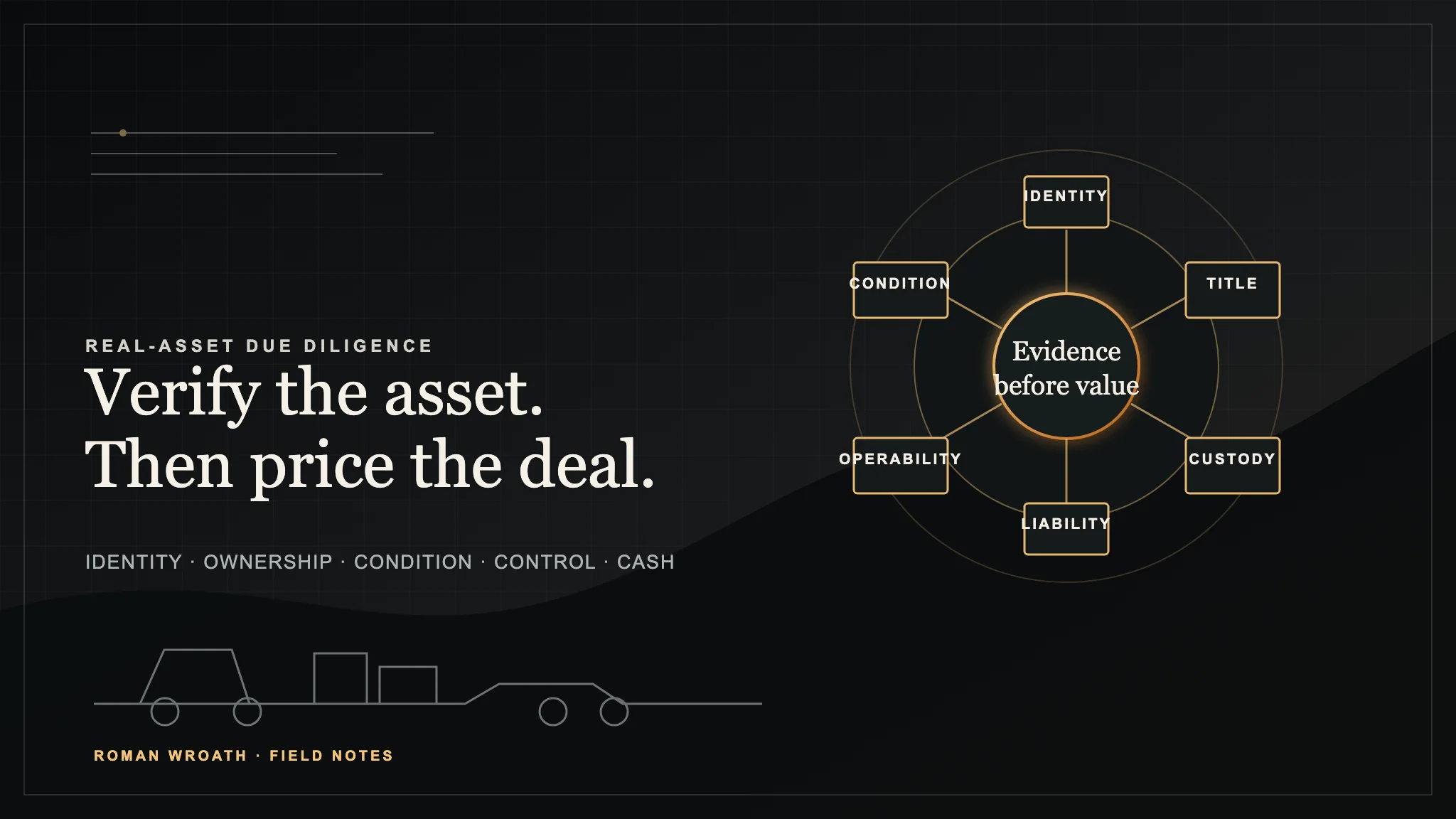
Price follows proof
Asset due diligence is often treated as an inspection exercise. Inspection matters, but it is only one part of the decision. The real task is to prove what is being acquired, who can transfer it, where it is, what condition it is in, which obligations come with it and how much capital will be required before it can perform.
That discipline applies across vessels, shipyards, industrial equipment, infrastructure, property and commodity parcels. The evidence changes by sector, but the core question does not: is the buyer valuing the asset that actually exists, or the asset described by the transaction narrative?
A discounted price is not automatically value. If title is unclear, access is restricted, records are unreliable or the operating plan requires more capital than the model assumes, the discount can disappear quickly.
Define the asset before reviewing it
The first step is to define the asset perimeter precisely. A trading name is not an asset. A factory is not one indivisible object. A vessel, production line or commodity parcel may include components owned by customers, landlords, finance providers, suppliers or other group companies.
The evidence should identify each material item through the strongest available reference: registry details, serial numbers, hull numbers, land parcels, equipment schedules, warehouse receipts, batch or lot numbers, software licences, drawings, tooling registers and controlled inventories. Photographs and site observations should be tied back to those records rather than filed as general proof that something was seen.
Perimeter errors are expensive because they distort everything that follows. Condition, replacement cost, revenue potential and security value are meaningless if the item being assessed is not actually included in the transaction.
Separate ownership, authority and custody
Ownership, authority to sell and physical custody are different facts. A party may possess an asset without owning it, own it without having unrestricted authority to transfer it, or hold legal title while another party controls access, data or essential documentation.
Title review should trace the acquisition chain and test registrations, liens, pledges, leases, retention-of-title rights, court restrictions, concessions, export controls and required consents. The seller's corporate authority, mandate and signing capacity should be verified independently. In distressed or court-led situations, the person negotiating may not be the person who can bind the estate or approve the transfer.
Custody needs equal attention. Keys, passwords, source files, maintenance systems, certificates, warehouse controls, original documents and the cooperation of people who know the asset can determine whether legal ownership becomes practical control after closing.
Reconcile paper, physical reality and people
Strong diligence triangulates three evidence sets: documents, physical inspection and operator knowledge. None is sufficient alone. Records can be incomplete, appearances can be staged and memories can be selective. The useful findings are often the points where the three do not reconcile.
A maintenance log may describe work that cannot be seen in the equipment. A production schedule may assume tooling that is missing or unusable. A warehouse certificate may not identify the exact lot offered for sale. A condition report may omit recurring faults known to operators. Each contradiction should be logged, assigned an owner and closed with evidence proportionate to its consequence.
This is why diligence is iterative. The first request produces a document set. The first inspection produces questions. Follow-up tests whether the explanation survives contact with source records, independent specialists and the people responsible for operating the asset.
Condition is not the same as operability
An asset can exist, look complete and still be unable to perform the buyer's plan. Operability depends on more than physical condition: approvals, utilities, software access, trained people, spares, supplier support, certifications, insurance, site rights, environmental limits and the intended duty cycle all matter.
The review should test the asset against the buyer's actual use case. What output is required? In which jurisdiction? Under what load, reliability and regulatory assumptions? When must operations begin? A machine that runs during a demonstration may still fail the production case. A vessel that passes a basic condition survey may still be unsuitable for the proposed route, class, flag or commercial duty.
The most useful output is therefore not a condition score. It is a bounded view of what can operate now, what must be rectified, what remains dependent on third parties and what could prevent the plan from working altogether.
Find the liabilities attached to the opportunity
Asset transactions are rarely free of obligations. Environmental exposure, employee claims, customer commitments, warranties, unpaid suppliers, taxes, decommissioning duties, disputed improvements and regulatory breaches can travel with the asset economically even where lawyers intend to separate them legally.
The diligence team should ask not only which liabilities transfer, but which liabilities the buyer will have to solve to preserve value. A key supplier may refuse to return without legacy arrears being addressed. Customers may control work in progress. A landlord may hold the access route. A licence may require consent. These dependencies can become part of the effective purchase price even when they are absent from the sale agreement.
Model the cash required to make the asset earn
Headline purchase price is only the first number. A realistic model includes inspection and closing costs, rectification, recommissioning, certification, inventory, working capital, insurance, people, utilities, supplier mobilisation, downtime and contingency. It should distinguish unavoidable capital from optional improvement and show the time required before revenue can be earned reliably.
A base case is not enough. The buyer should model what happens if the restart is delayed, output is lower, a critical component is obsolete, a permit takes longer or a customer obligation consumes cash before new sales arrive. The purpose is not to make every case pessimistic. It is to identify which assumptions carry the valuation.
A useful investment number is the all-in cash to control, stabilise and operate the asset—not simply the amount paid at completion.
Make diligence change the deal
Due diligence has failed if the report records risk but the transaction proceeds unchanged. Findings should influence price, perimeter, conditions precedent, completion deliverables, escrow, holdbacks, warranties, independent testing, seller rectification, access rights, transition support or the decision to walk away.
A simple evidence ledger helps. Each material question should show the claim, source, verification status, consequence, evidence required, owner and decision deadline. That structure prevents repeated assertions from becoming facts and makes it clear when an assumption has expired.
The standard for closure should reflect consequence. A minor equipment discrepancy may need a cost allowance. Unclear title, unverifiable inventory or an unsupported operating permit may require resolution before signing or completion. Not every uncertainty must be eliminated, but every material uncertainty should be owned, priced or protected.
The asset should survive the story
Good asset due diligence is not designed to kill transactions. It makes the opportunity more executable by separating real value from assumptions, clarifying the capital required and preserving leverage while alternatives still exist.
The decisive question is simple: if the presentation, valuation and urgency disappeared, would the evidence still support ownership, control, operability and the commercial plan? If the asset survives that test, pricing can begin on firmer ground. If it does not, the buyer has learned something valuable before money moved.
This is an operator's perspective, not legal, financial or investment advice. Specialist legal, tax, environmental, technical and regulatory review should be matched to the asset and jurisdiction.
Discuss the acquisition
Evaluating a real asset, operating business or industrial opportunity?
For evidence-led asset review, technical diligence and operational planning, contact Roman Wroath.